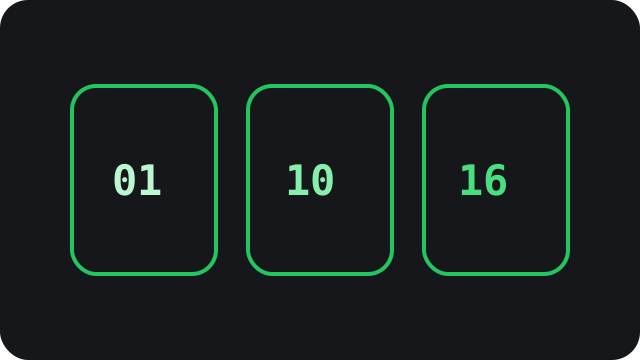
Concept and context
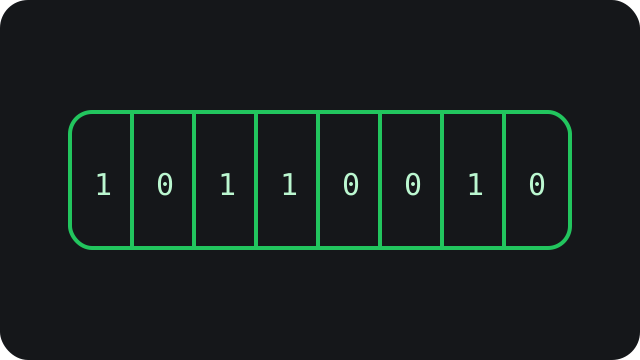
A bit represents two states, a nibble groups four bits and a modern byte contains eight.
These units describe representation capacity, while the meaning of a bit pattern depends on its type: unsigned integer, signed integer, character, floating point or something else.
A sound mental model separates the abstract concept from its concrete representation and from the environment in which it is used. That separation prevents assumptions that are valid for one protocol, library or format from being carried into systems whose rules or guarantees are different.
Fundamentals and terminology
A fixed-width integer uses a predetermined number of bits and therefore has a finite range.
With n unsigned bits the range is 0 through 2^n-1; a typical n-bit two's-complement signed integer ranges from -2^(n-1) through 2^(n-1)-1.
Terminology should be read together with the standard, version or contract that defines it, because similar words can describe different properties at different layers. Making those definitions explicit improves interoperability, documentation and the ability to diagnose unexpected behavior.
How it works
Two's complement represents negative values so addition and subtraction can reuse modular binary arithmetic.
The most significant bit contributes a negative weight and overflow discards bits beyond the chosen width according to the language or machine rules.
In real systems it helps to follow data across layers and identify which transformations are reversible, which introduce constraints and where information can be lost. This makes responsibilities among producers, consumers, storage and transport easier to reason about and test.
Worked example
The byte 11111111 is 255 as an unsigned 8-bit integer but -1 as a signed 8-bit two's-complement integer.
The bit pattern itself does not encode signedness; the surrounding type tells software which mathematical value to interpret.
A worked example becomes reusable when it exposes its preconditions and invariants rather than showing only an end result. Changing one assumption at a time helps distinguish behavior guaranteed by a standard from choices made by a particular application or implementation.
Errors and misconceptions
Changing number base does not change a value, but interpreting a hexadecimal bit pattern as a signed integer of a specific width can make the displayed number negative.
Confusing logical and arithmetic shifts or ignoring overflow and sign extension causes low-level bugs.
Many failures come from implicit assumptions between systems that look compatible while using different versions, canonicalization rules or type models. For interoperability and security, unusual inputs should therefore be specified and tested deliberately instead of being treated as irrelevant edge cases.
Best practices and selection criteria
Specify width, signedness and endianness whenever binary representations cross a boundary.
Use sufficiently wide types, validate overflow and keep notation conversion separate from reinterpreting the same bits under a different type.
Robust practice combines documented standards, mature libraries, explicit contracts and tests that include representative boundary cases. The best choice is not automatically the shortest or most popular one; portability, readability, performance, security, evolution and operating cost all matter.