Understand more, choose with confidence
Practical, reasoned guides to formats, text, security, identifiers and the concepts we meet every day in software.

Base64: binary data as text
How Base64 maps bytes to a restricted ASCII alphabet, why it expands data and which variant fits each protocol.
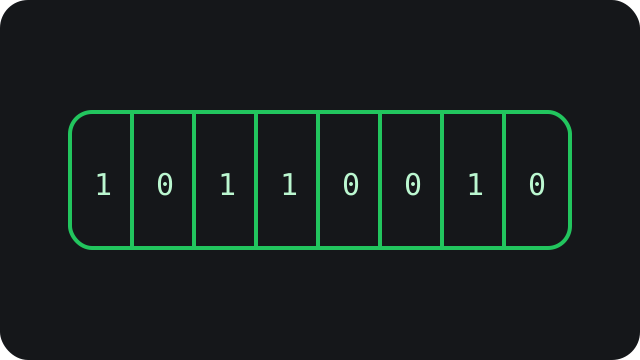
Bits, bytes, nibbles, fixed-width integers and two's complement
How computers represent bits and signed integers, and why width and interpretation change the observed value.
Data serialization and deserialization
How in-memory structures become transferable representations and what can break across types, versions and systems.
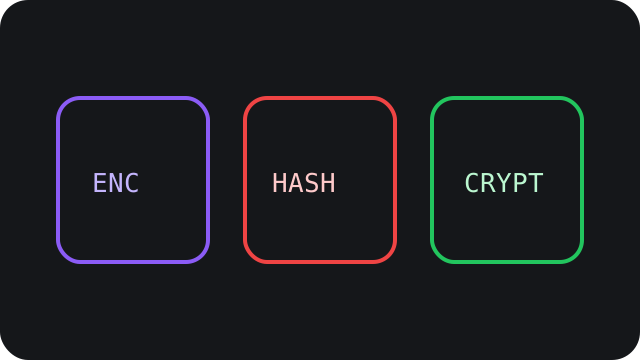
Encoding, hashing and encryption: differences and use cases
Three commonly confused transformations: representation, one-way digests and reversible key-based cryptographic protection.

Escaping vs sanitization: HTML contexts and XSS prevention
Why contextual escaping and sanitization solve different problems and how to prevent untrusted input from becoming active markup.
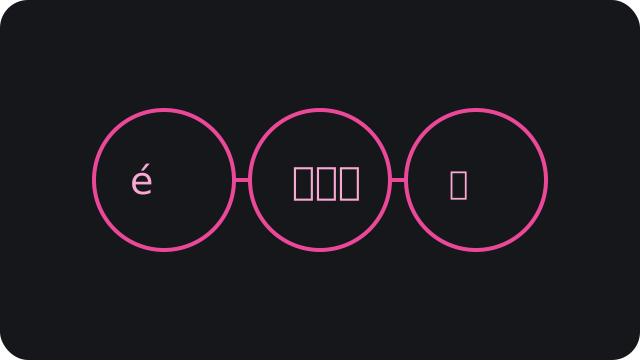
Grapheme clusters, code points and bytes: what a “character” really means
Why one visible character may contain multiple code points and many bytes, and how to choose the right metric.

Hash functions: digests, integrity and security
Cryptographic hash properties, SHA, collisions, HMAC, password hashing and the difference from encryption.
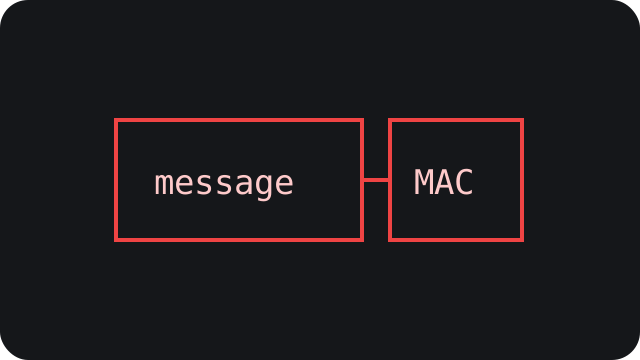
HMAC, checksums and integrity verification
The difference between accidental error detection, cryptographic digests and shared-secret message authentication.

HTML entities, escaping and markup security
HTML character references, numeric references, contextual escaping, sanitization and their relationship to XSS prevention.

JSON Schema: describing and validating data structures
How JSON Schema expresses types, properties, constraints, composition and compatibility for JSON documents.
JSON vs YAML vs XML: choosing the right format
A reasoned comparison of JSON, YAML and XML for APIs, configuration, documents, schemas and interoperability.

JSON: syntax, types, structure and validation
A complete guide to JSON as a data-interchange format: grammar, types, parsing, serialization, validation and interoperability.

Number systems: binary, octal, decimal and hexadecimal
Positional bases, conversion, computer representations and the difference between mathematical value and bit interpretation.

Query strings and application/x-www-form-urlencoded
Query-string structure, name/value pairs, percent-encoding and the distinct rules used by HTML form encoding.
Software naming conventions: camelCase, PascalCase, snake_case and kebab-case
How to choose and apply consistent naming conventions across code, APIs, files, URLs and databases.

Unicode and UTF-8: code points, bytes and characters
How Unicode assigns code points and UTF-8 encodes them as bytes, with consequences for text, storage and interoperability.

Unix timestamp, Epoch and time representation
How to represent instants, distinguish UTC, offsets and time zones, and handle seconds, milliseconds and ISO 8601.

URI normalization, reserved/unreserved characters and equivalence
When two URIs can be treated as equivalent and why canonicalization and percent-encoding require context.

URL, URI and percent-encoding
How URI and URL components are structured, which characters carry syntax and when percent-encoding is required.

UTC, offsets, time zones, DST and ISO 8601
How to distinguish absolute instants, UTC offsets and geographic time-zone rules in software systems.
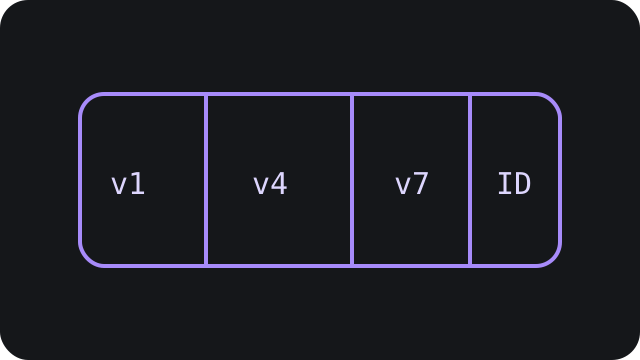
UUID v1, v4 and v7: generation, ordering, collisions and ID design
Comparing UUID versions and choosing between random, time-based and time-sortable identifiers.

UUID: unique identifiers, versions and uses
UUID structure, variants and versions, collision probability and design choices for distributed identifiers.
XML: elements, attributes, namespaces and documents
XML fundamentals: tree structure, attributes, namespaces, encoding, validation and interoperability.
YAML: syntax, types and structures
A guide to YAML as a human-readable serialization format: scalars, collections, indentation, anchors and parsing pitfalls.