Concept and context
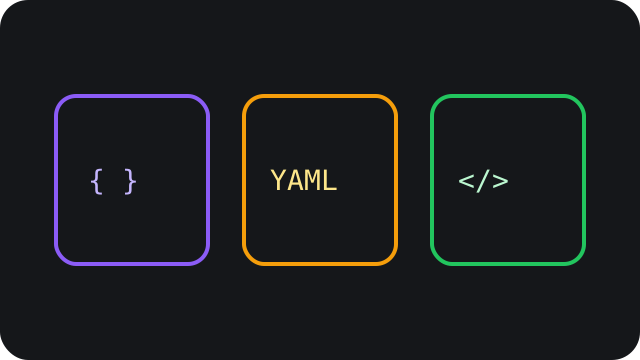
JSON, YAML and XML can all represent structured data, but they optimize different needs.
Choosing solely by popularity ignores human editing, parser complexity, schema requirements, mixed content, namespaces and ecosystem constraints.
A sound mental model separates the abstract concept from its concrete representation and from the environment in which it is used. That separation prevents assumptions that are valid for one protocol, library or format from being carried into systems whose rules or guarantees are different.
Fundamentals and terminology
JSON has a small and predictable data model; YAML prioritizes manual authoring with a richer syntax; XML models document trees with attributes, namespaces and mixed content.
Those distinctions affect round trips, validation and available tooling.
Terminology should be read together with the standard, version or contract that defines it, because similar words can describe different properties at different layers. Making those definitions explicit improves interoperability, documentation and the ability to diagnose unexpected behavior.
How it works
JSON is often the default for web APIs because support is ubiquitous and semantics are comparatively small.
YAML is common for configuration-as-code, while XML remains strong when namespaces, rich documents, XSD or transformation pipelines matter.
In real systems it helps to follow data across layers and identify which transformations are reversible, which introduce constraints and where information can be lost. This makes responsibilities among producers, consumers, storage and transport easier to reason about and test.
Worked example
A REST service might use JSON for payloads, YAML for deployment configuration and XML for a legacy document protocol.
Different formats in different boundaries are not inconsistent when each choice answers concrete requirements and conversion points are explicit.
A worked example becomes reusable when it exposes its preconditions and invariants rather than showing only an end result. Changing one assumption at a time helps distinguish behavior guaranteed by a standard from choices made by a particular application or implementation.
Errors and misconceptions
YAML is not always more readable for deeply nested data, and XML is not inherently too verbose when its namespace model solves real problems.
Converting formats may also lose comments, ordering, tags, attributes or implicit type distinctions.
Many failures come from implicit assumptions between systems that look compatible while using different versions, canonicalization rules or type models. For interoperability and security, unusual inputs should therefore be specified and tested deliberately instead of being treated as irrelevant edge cases.
Best practices and selection criteria
Evaluate producers and consumers, contract stability, human-editing needs, parser security and schema requirements before choosing.
Document encoding and canonicalization whenever signatures, caching or textual diffs depend on representation details.
Robust practice combines documented standards, mature libraries, explicit contracts and tests that include representative boundary cases. The best choice is not automatically the shortest or most popular one; portability, readability, performance, security, evolution and operating cost all matter.