Concept and context
A query is the URI component following the question mark, and generic URI syntax does not mandate one universal key/value grammar.
On the web, name=value pairs separated by ampersands are common, but frameworks and servers still define how repeated or missing values are interpreted.
A sound mental model separates the abstract concept from its concrete representation and from the environment in which it is used. That separation prevents assumptions that are valid for one protocol, library or format from being carried into systems whose rules or guarantees are different.
Fundamentals and terminology
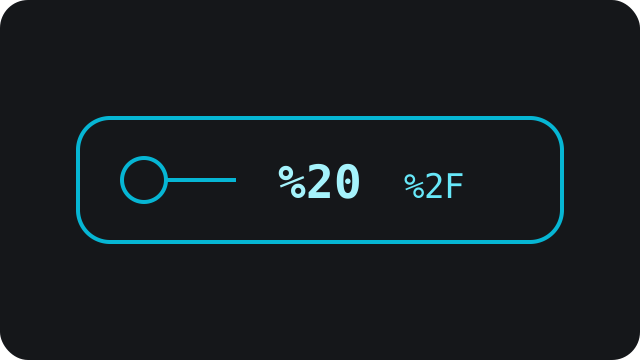
application/x-www-form-urlencoded is the historic HTML form representation and follows rules related to but distinct from generic URI percent-encoding.
Spaces are normally serialized as +, while a literal plus sign must be encoded so it cannot be confused with that convention.
Terminology should be read together with the standard, version or contract that defines it, because similar words can describe different properties at different layers. Making those definitions explicit improves interoperability, documentation and the ability to diagnose unexpected behavior.
How it works
Browsers and libraries serialize successful form controls into ordered name/value pairs, encode them and place the result in a body or query.
Repeated names, empty fields and ordering can matter, so the data model is not always equivalent to a simple dictionary.
In real systems it helps to follow data across layers and identify which transformations are reversible, which introduce constraints and where information can be lost. This makes responsibilities among producers, consumers, storage and transport easier to reason about and test.
Worked example
tags=api&tags=json carries two values for the same name and should not be silently collapsed to one.
A query q=a+b represents a space under form encoding, whereas a literal plus sign needs an unambiguous encoded representation.
A worked example becomes reusable when it exposes its preconditions and invariants rather than showing only an end result. Changing one assumption at a time helps distinguish behavior guaranteed by a standard from choices made by a particular application or implementation.
Errors and misconceptions
Applying query decoding to a complete URL can damage structural delimiters.
Double-decoding data that has already been interpreted is another common error and can turn literal percent sequences into new characters with routing or validation consequences.
Many failures come from implicit assumptions between systems that look compatible while using different versions, canonicalization rules or type models. For interoperability and security, unusual inputs should therefore be specified and tested deliberately instead of being treated as irrelevant edge cases.
Best practices and selection criteria
Use standard URL and form APIs, define repeated-key and null-value behavior explicitly and decode once at the correct layer.
For complex payloads, prefer a structured body format rather than inventing nested grammars inside query parameters.
Robust practice combines documented standards, mature libraries, explicit contracts and tests that include representative boundary cases. The best choice is not automatically the shortest or most popular one; portability, readability, performance, security, evolution and operating cost all matter.