Concept and context
In everyday language a character is one perceived symbol, but digital text has several layers.
Bytes, Unicode code points and grapheme clusters measure different aspects of representation and cannot be used interchangeably.
A sound mental model separates the abstract concept from its concrete representation and from the environment in which it is used. That separation prevents assumptions that are valid for one protocol, library or format from being carried into systems whose rules or guarantees are different.
Fundamentals and terminology
An extended grapheme cluster groups code points that should behave as one user-perceived unit according to Unicode segmentation rules.
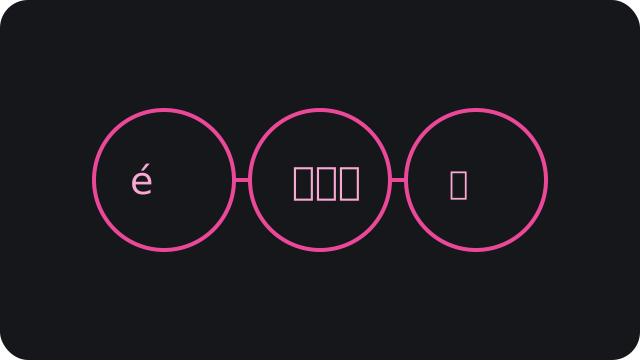
Combining accents, skin-tone modifiers, ZWJ emoji sequences and regional-indicator flags demonstrate why string length is not a single universal concept.
Terminology should be read together with the standard, version or contract that defines it, because similar words can describe different properties at different layers. Making those definitions explicit improves interoperability, documentation and the ability to diagnose unexpected behavior.
How it works
Unicode segmentation algorithms locate grapheme boundaries using code-point properties and standardized rules.
Editors, cursor movement, selection and deletion often need those boundaries, while protocols and storage may instead care about encoded bytes.
In real systems it helps to follow data across layers and identify which transformations are reversible, which introduce constraints and where information can be lost. This makes responsibilities among producers, consumers, storage and transport easier to reason about and test.
Worked example
A family emoji can render as one glyph while containing several emoji joined by zero-width joiners and occupying many UTF-8 bytes.
A limit of 20 bytes, 20 code points and 20 graphemes therefore describes three different constraints.
A worked example becomes reusable when it exposes its preconditions and invariants rather than showing only an end result. Changing one assumption at a time helps distinguish behavior guaranteed by a standard from choices made by a particular application or implementation.
Errors and misconceptions
Calling a language's len function without understanding its unit can create inconsistent UI limits and slicing bugs that break visual sequences.
Grapheme count is not identical to terminal display width either, because fonts and emoji presentation affect rendering.
Many failures come from implicit assumptions between systems that look compatible while using different versions, canonicalization rules or type models. For interoperability and security, unusual inputs should therefore be specified and tested deliberately instead of being treated as irrelevant edge cases.
Best practices and selection criteria
Choose the unit according to the requirement: bytes for storage or protocol limits, code points for some Unicode algorithms and graphemes for user interaction.
Test combining marks, ZWJ emoji and non-Latin scripts rather than validating only ASCII input.
Robust practice combines documented standards, mature libraries, explicit contracts and tests that include representative boundary cases. The best choice is not automatically the shortest or most popular one; portability, readability, performance, security, evolution and operating cost all matter.