Concept and context
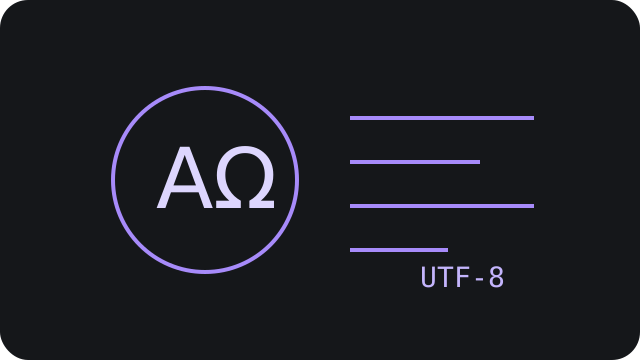
Unicode defines a repertoire and model for representing text from many writing systems through abstract code points.
UTF-8 is a concrete encoding that maps those code points to one-to-four-byte sequences while preserving ASCII byte values for the first 128 characters.
A sound mental model separates the abstract concept from its concrete representation and from the environment in which it is used. That separation prevents assumptions that are valid for one protocol, library or format from being carried into systems whose rules or guarantees are different.
Fundamentals and terminology
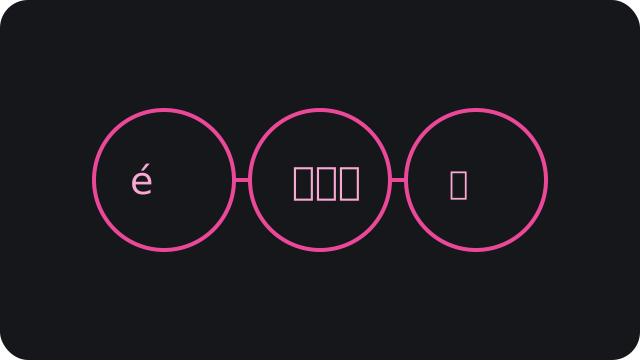
A code point is commonly written as U+XXXX and does not always correspond to one user-perceived character.
UTF-8 has strict sequence rules, which makes malformed byte sequences detectable instead of leaving decoding entirely ambiguous.
Terminology should be read together with the standard, version or contract that defines it, because similar words can describe different properties at different layers. Making those definitions explicit improves interoperability, documentation and the ability to diagnose unexpected behavior.
How it works
Encoding starts from Unicode code points and produces UTF-8 bytes; decoding performs the reverse operation.
Unicode normalization addresses a different issue: canonically equivalent sequences such as a precomposed accented letter and a base letter followed by a combining mark.
In real systems it helps to follow data across layers and identify which transformations are reversible, which introduce constraints and where information can be lost. This makes responsibilities among producers, consumers, storage and transport easier to reason about and test.
Worked example
The letter A occupies one UTF-8 byte, many scripts and symbols use two or three, and numerous emoji use four.
Byte length, code-point count and visible-character count can therefore all differ for the same text.
A worked example becomes reusable when it exposes its preconditions and invariants rather than showing only an end result. Changing one assumption at a time helps distinguish behavior guaranteed by a standard from choices made by a particular application or implementation.
Errors and misconceptions
Assuming one byte per character corrupts international text, and slicing arbitrary byte positions can split a UTF-8 sequence.
Comparing strings without a normalization policy can also treat canonically equivalent text as different identifiers.
Many failures come from implicit assumptions between systems that look compatible while using different versions, canonicalization rules or type models. For interoperability and security, unusual inputs should therefore be specified and tested deliberately instead of being treated as irrelevant edge cases.
Best practices and selection criteria
Use UTF-8 end to end when possible, validate bytes at trust boundaries and name byte, code-point and grapheme measurements explicitly in APIs.
Normalize only for a defined domain reason and preserve original text when exact representation matters.
Robust practice combines documented standards, mature libraries, explicit contracts and tests that include representative boundary cases. The best choice is not automatically the shortest or most popular one; portability, readability, performance, security, evolution and operating cost all matter.