Concept and context
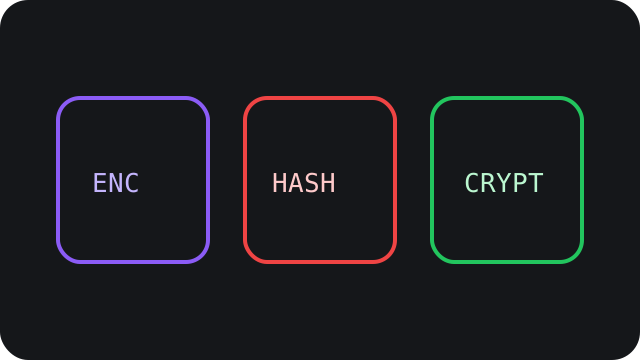
Checksums, cryptographic hashes and HMAC can all reveal changes, but they address different threat models.
Checksums target accidental corruption, strong hashes resist deliberate collision attacks better and HMAC authenticates data to parties that share a secret key.
A sound mental model separates the abstract concept from its concrete representation and from the environment in which it is used. That separation prevents assumptions that are valid for one protocol, library or format from being carried into systems whose rules or guarantees are different.
Fundamentals and terminology
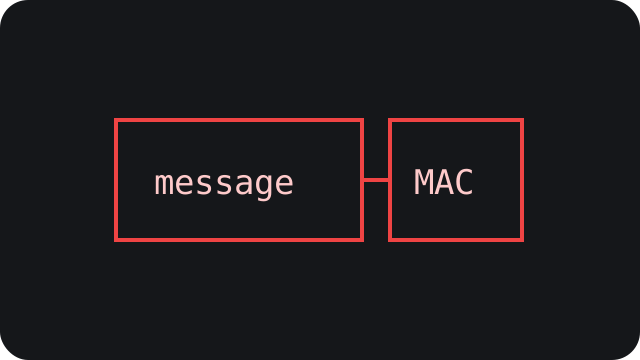
CRC is designed for transmission errors rather than adversaries; SHA-256 produces a digest without a secret; HMAC builds a message authentication code from a hash and key.
Integrity alone does not identify the producer when anyone can recompute the same public digest.
Terminology should be read together with the standard, version or contract that defines it, because similar words can describe different properties at different layers. Making those definitions explicit improves interoperability, documentation and the ability to diagnose unexpected behavior.
How it works
A sender computes HMAC over a canonical byte representation and the receiver recomputes it with the shared key.
Exact serialization, key handling, algorithm choice and constant-time comparison are part of the protocol rather than optional implementation details.
In real systems it helps to follow data across layers and identify which transformations are reversible, which introduce constraints and where information can be lost. This makes responsibilities among producers, consumers, storage and transport easier to reason about and test.
Worked example
A file distributed with a trusted SHA-256 digest can reveal download corruption.
A webhook signed with HMAC can authenticate its payload as well, provided secrets, canonicalization and replay protection are handled deliberately.
A worked example becomes reusable when it exposes its preconditions and invariants rather than showing only an end result. Changing one assumption at a time helps distinguish behavior guaranteed by a standard from choices made by a particular application or implementation.
Errors and misconceptions
Publishing a hash and file through the same compromised channel does not create authenticity, and CRC is inadequate against an attacker.
Signing one representation and verifying another, such as reordered JSON, also fails even when the semantic data seems equivalent.
Many failures come from implicit assumptions between systems that look compatible while using different versions, canonicalization rules or type models. For interoperability and security, unusual inputs should therefore be specified and tested deliberately instead of being treated as irrelevant edge cases.
Best practices and selection criteria
Use checksums for accidental errors, hashes for fingerprints and trusted-reference integrity, HMAC for shared-secret authentication and digital signatures when public verification is needed.
Version the signed format and include timestamps or nonces when replay attacks matter.
Robust practice combines documented standards, mature libraries, explicit contracts and tests that include representative boundary cases. The best choice is not automatically the shortest or most popular one; portability, readability, performance, security, evolution and operating cost all matter.