Concept and context
Encoding, hashing and encryption transform data for different goals, and confusing them creates security and interoperability failures.
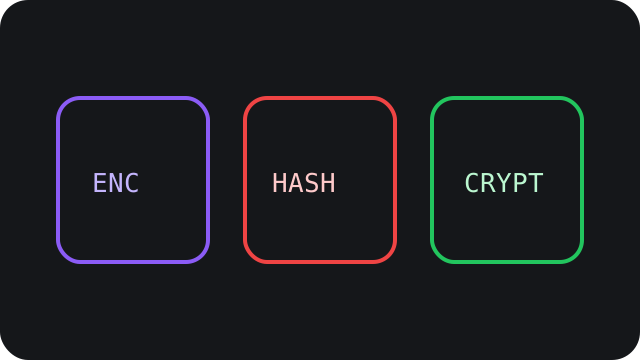
Encoding changes representation, hashing derives a digest and encryption protects confidentiality with a key.
A sound mental model separates the abstract concept from its concrete representation and from the environment in which it is used. That separation prevents assumptions that are valid for one protocol, library or format from being carried into systems whose rules or guarantees are different.
Fundamentals and terminology
Base64 is reversible encoding with no secret; SHA-256 is a deterministic hash designed to be one-way; AES is a symmetric cipher that requires a key.
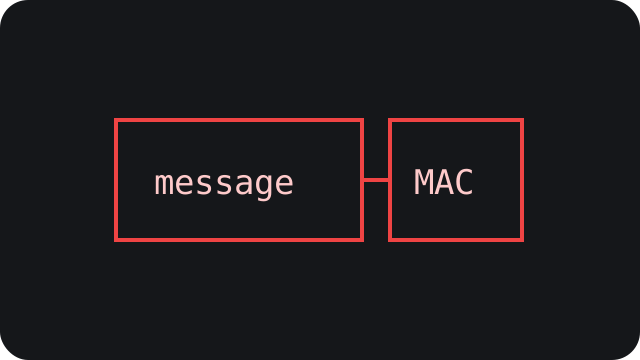
HMAC combines a hash with a shared secret to provide message authenticity and integrity.
Terminology should be read together with the standard, version or contract that defines it, because similar words can describe different properties at different layers. Making those definitions explicit improves interoperability, documentation and the ability to diagnose unexpected behavior.
How it works
Encoding maps bytes into an alphabet suitable for a channel, hashing compresses arbitrary input to fixed-size output and encryption turns plaintext into ciphertext.
Cryptographic security also depends on key handling, mode, nonce rules and the surrounding protocol.
In real systems it helps to follow data across layers and identify which transformations are reversible, which introduce constraints and where information can be lost. This makes responsibilities among producers, consumers, storage and transport easier to reason about and test.
Worked example
A binary attachment can be Base64-encoded for JSON transport, checked with SHA-256 after transfer and encrypted with an authenticated cipher when confidentiality is required.
These operations can coexist because they solve distinct problems.
A worked example becomes reusable when it exposes its preconditions and invariants rather than showing only an end result. Changing one assumption at a time helps distinguish behavior guaranteed by a standard from choices made by a particular application or implementation.
Errors and misconceptions
Base64 does not hide information and a fast general-purpose hash does not protect passwords against guessing attacks.
Encryption without authentication may permit tampering, while nonce reuse in modes that prohibit it can destroy otherwise strong guarantees.
Many failures come from implicit assumptions between systems that look compatible while using different versions, canonicalization rules or type models. For interoperability and security, unusual inputs should therefore be specified and tested deliberately instead of being treated as irrelevant edge cases.
Best practices and selection criteria
Start by naming the required property: transport compatibility, integrity, authenticity or confidentiality.
Use standard primitives and mature libraries, dedicated password hashing for passwords and authenticated encryption when data must resist both reading and modification.
Robust practice combines documented standards, mature libraries, explicit contracts and tests that include representative boundary cases. The best choice is not automatically the shortest or most popular one; portability, readability, performance, security, evolution and operating cost all matter.